Until late in his life, my dad still had the camp kitchen referenced by Mama J in this section, and my brother, Mike, has now created his own version. I suspect the second, smaller “beverage” cooler mentioned here was mainly for my dad’s beer! NOTE: I have included minor edits (punctuation, mainly), but the text mostly remains as it appears in the original. The boldfaced subheadings/intros are mine.
Getting the Hang of Things, Plus Animal Encounters!
One of the things we learned from our friends was to use a camp kitchen. Camping supply stores carry a variety of them. Some are in kit form, ready to be assembled. Some are pre-finished and ready to use. We designed and made our own to fit our space requirements. Basically, a camp kitchen is a large plywood box. It’s used as a pantry, dish-washing center, and cook gear center. Filled to absolutely top capacity for a long-term trip, ours weighs about 57 pounds.
Our camp kitchen has a silverware drawer with a slightly reshaped plastic divider in it. In addition to silverware, it holds Band-Aids, spare shoelaces, mantles for the lantern, the ice pick, and a spare generator for the stove. There are shelves for cups and plates. One section is very deep for the large kettle we carry. Nestled in the kettle are a mix/serve bowl, soup bowls, potholders, the can opener, soup ladle, salt and pepper shakes, clothespins, and whatever other small stuff I can cram in. We started out with an inexpensive can opener, which I rapidly abandoned for a very high quality one. I refused to be plagued by one that didn’t always work.

The other half of the kitchen has adjustable shelves for canned goods, the dishpans, saucepan, skillet, and a multitude of small things tucked in, such as the cribbage board and cards. My cooking equipment is very basic. I carry a 9” cast iron skillet, a two-quart saucepan with lid, the deep kettle mentioned before, and a rectangular griddle. Anything that can’t be cooked within those limitations doesn’t get cooked. The deep kettle does double-duty as it’s used to heat dishwater. Our silverware is an old set that we had replaced for home use. The dishes are plastic ones I’d found on sale at the supermarket. The saucepan is the only piece of equipment I take from my home kitchen. Everything else has a permanent place in the camp kitchen. That saves one big lot of list-making and cross-checking.
With acquiring a camp kitchen, we suddenly found we simply didn’t have enough room anymore. We had a Volkswagen Fastback and were sandwiched in. Getting started on camping, we quickly discovered, was expensive, as we added a car-top carrier to hold the kitchen. That was going to be it. We simply could not afford to buy any more equipment that year, but it would be nice to have a stove to cook on. We found a two-burner gas stove on sale, and that definitely was it. Every time we wanted a meal, Al had to light the stove, as I was afraid of it. Even the children light it now, though we all have respect for it. I’ve taken all the hair off my arm more than once through carelessness.
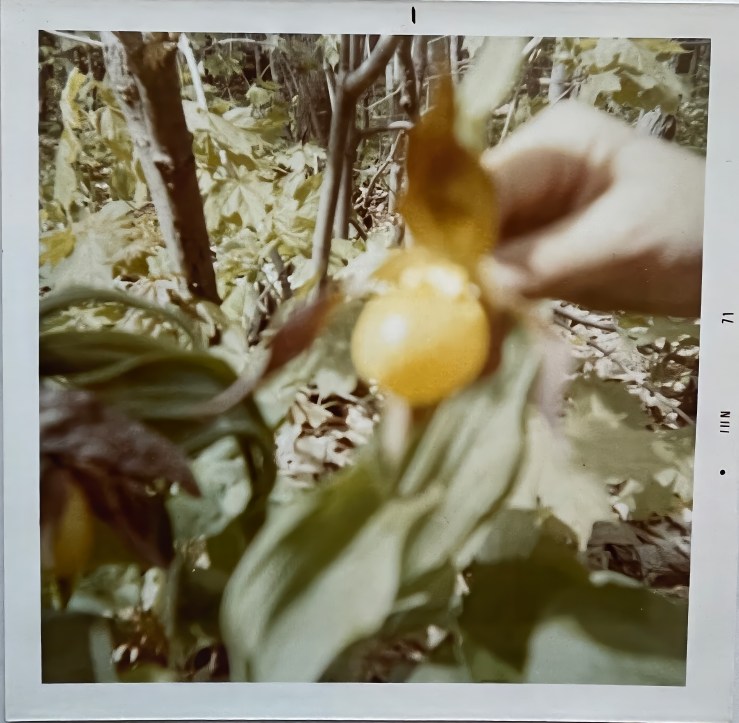
Freshly equipped, we set out again and discovered Door County, Wisconsin. Door County is the “thumb” when you look at a map of Wisconsin. It’s a crazy-quilt mixture of resort sophistication, native crafts, tiny towns, and state parks offering beautiful camping. It’s one of our very favorite places. Door County caused us to add the bird identification book, field glasses, and a wildflower guide to our camping gear. We found our first, and only, lady’s slipper there. We also became acquainted with campground raccoons while camping there.
We were using two Styrofoam coolers: a large one as our refrigerator and a small one for a beverage cooler. One night, we stacked the little one on the big one and went off to bed. Al woke up to a great commotion. The small cooler had been knocked off the large one, the lid of the large one was chewed, the bacon was full of teeth marks, and the butter was missing—not the margarine—the butter. Only a Wisconsin raccoon would steal butter! Raccoons get very fresh. The least little bit of food left around a site will draw them like a magnet. It’s very common to get up in the morning and see their little hand-like prints on the table or kitchen. One has even taken a whole loaf of bread and run off with it.
One night, we were sitting around the fire, when the daughter of our friends said quietly to look. Mama raccoon was off a ways, but four kits were within our touching reach had we been so inclined. We practically stopped breathing to watch them carefully exploring our site. It was all the more fascinating as our friends’ dog slept through the whole visit, utterly oblivious to the raccoons’ presence!
Garbage disposal must be done properly, or all sorts of animals and insects will visit. I usually keep a small garbage container within easy reach and dispose of a whole day’s worth after our evening meal in the regular trash cans provided. One night, I forgot. Al woke to a crash and found an enormous skunk merrily chomping away on some pork chop bones. He hastily retreated into the tent. The next night, we deliberately left scraps hoping we could get a picture of our raider, but we did not.

 Gail Suberbielle Photography
[…] Next up: Getting the Hang of Things! […]
LikeLike